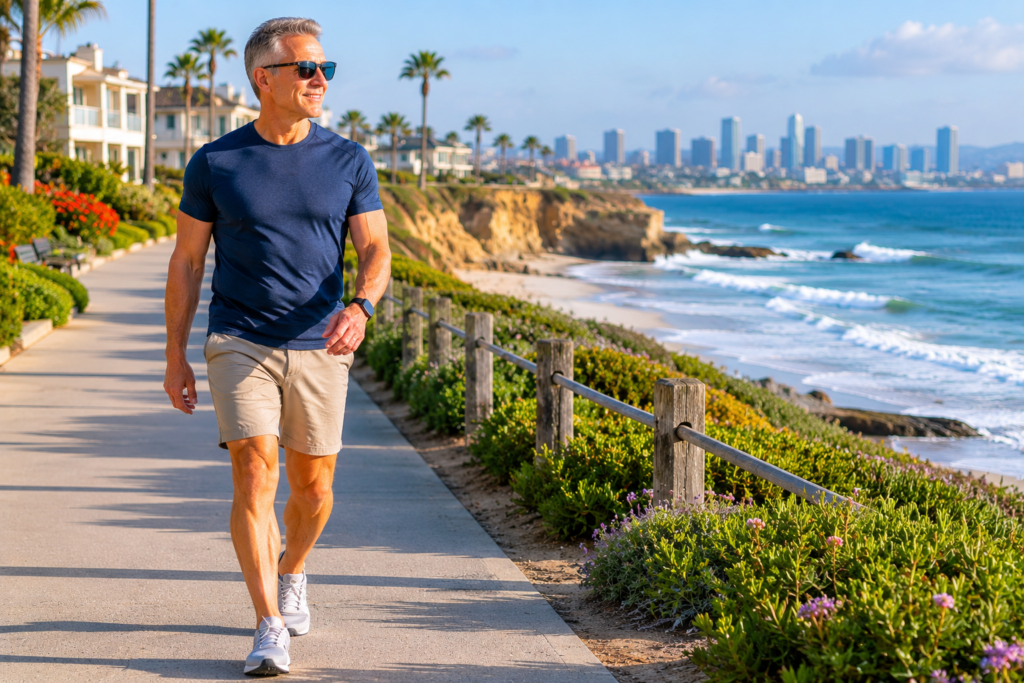
It supports:
- cardiovascular health,
- mental well-being,
- circulation,
- energy,
- and overall longevity.
But many men over 55 make the mistake of believing that walking alone is enough to maintain strength, mobility, balance, and long-term physical capability.
It’s not.
Walking is excellent foundational movement — but it does not fully address many of the physical changes that naturally occur with aging.
That’s why many men who walk regularly still experience:
- stiffness,
- declining balance,
- reduced strength,
- poor posture,
- tight hips,
- unstable movement,
- or feeling less athletic than they once did.
The issue is not that walking is bad.
The issue is that the body requires more variety and challenge to age well.
What Walking Does Well
Walking helps maintain:
- basic movement,
- cardiovascular fitness,
- joint circulation,
- and daily activity levels.
It’s also sustainable, accessible, and relatively low-impact.
For many men, regular walking is one of the healthiest habits they maintain consistently.
And that matters.
But healthy aging requires more than simply staying active.
It requires maintaining physical capability.
What Walking Does Not Fully Train
Walking primarily moves the body in a straight line through a limited range of motion.
What it doesn’t significantly develop is:
- balance,
- lateral movement,
- mobility,
- reaction time,
- rotational strength,
- joint stability,
- or functional strength.
These are often the exact abilities men lose fastest as they age.
Related:
- “How Poor Balance Quietly Predicts Faster Aging in Men Over 60”
- “The Real Reason Men Over 55 Feel Stiff — And Why Stretching Alone Doesn’t Fix It”
This is one reason many men continue walking regularly yet still feel:
- stiff,
- unstable,
- weaker,
- or physically older over time.
Why Strength and Mobility Matter After 55
After 55, the body naturally begins losing:
- muscle mass,
- coordination,
- balance,
- power,
- and joint mobility.
Without intentional training, these declines accelerate.
This is where mobility work, balance training, and functional strength become critical.
Training these qualities helps men:
- move more confidently,
- maintain independence,
- improve posture,
- reduce stiffness,
- and continue doing the activities they enjoy.
Many men are surprised by how quickly they begin feeling stronger and more capable once they start training movement quality instead of relying on walking alone.
Aging Athletically Requires More Than Cardio
The goal is not simply avoiding disease.
The goal is maintaining a body that supports:
- travel,
- golf,
- hiking,
- exercise,
- lifting grandchildren,
- daily movement,
- and an active lifestyle for decades to come.
That requires:
- mobility,
- strength,
- balance,
- coordination,
- and stability.
The men who age best are typically not the ones doing the hardest workouts.
They are the ones consistently maintaining movement quality and physical capability over time.
Movement Quality Changes Everything
Many men assume feeling stiff, unstable, or less athletic is simply inevitable after a certain age.
But in many cases, the body is simply undertrained in the areas that matter most for healthy aging.
With proper training, men can often improve:
- mobility,
- posture,
- strength,
- balance,
- coordination,
- and confidence moving
well into their 60s and 70s.
Because ultimately, aging well is not just about living longer.
It’s about continuing to live actively, confidently, and fully in your body.
Want Help Improving Mobility, Strength, and Balance?
Vasanta Yoga provides personalized private movement coaching for men 55+ focused on mobility, balance, strength, and long-term vitality.
Sessions are designed to help men reduce stiffness, improve movement quality, increase confidence, and maintain an active, capable lifestyle as they age.
About Margy Goodman
Margy Goodman is the founder of Vasanta Yoga and a Private Vitality & Longevity Specialist based in San Diego. She works with men 55+ to improve mobility, balance, strength, and long-term physical capability through personalized movement coaching.
