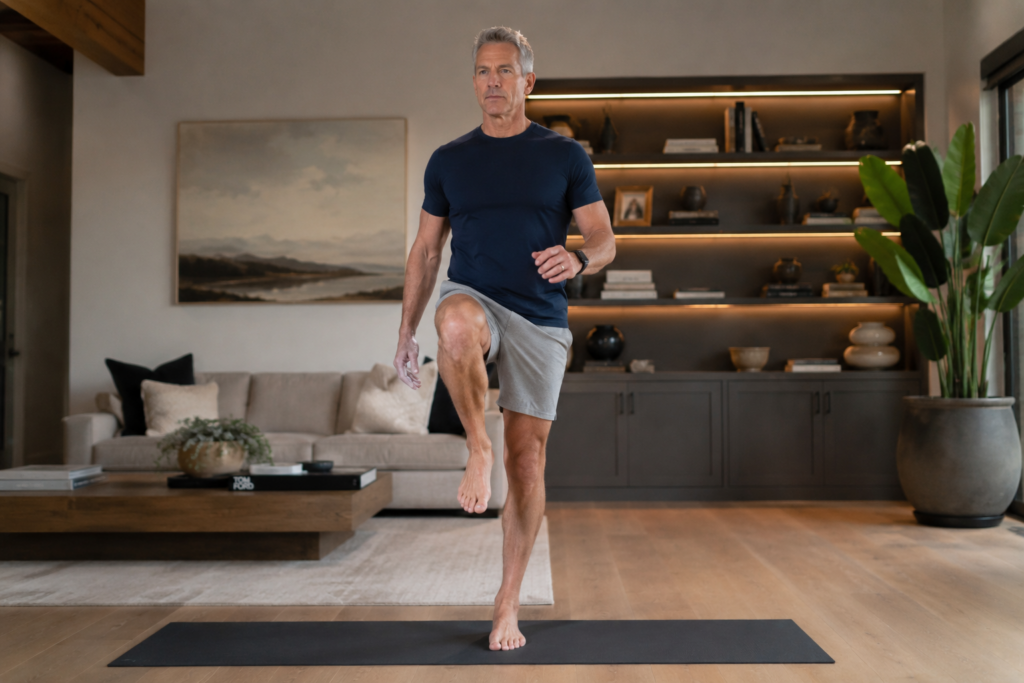
Most men don’t think much about balance — until they start losing it.
It usually happens gradually.
You may notice:
- feeling less stable on one leg,
- needing to hold the railing on stairs,
- hesitating on uneven ground,
- feeling less coordinated,
- or simply moving with less confidence than you used to.
Many people assume this is just a normal part of aging.
But poor balance is more than an inconvenience.
Research increasingly shows that declining balance is strongly connected to overall health, longevity, mobility, and independence as we age. Older adults with impaired balance have significantly higher risks of falls, injury, and loss of physical function.
And importantly: balance is trainable.
Why Balance Matters More Than Most Men Realize
Balance is not just about preventing falls.
Good balance reflects the health and coordination of multiple systems working together:
- muscles,
- joints,
- vision,
- core stability,
- nervous system function,
- posture,
- and reaction time.
When balance declines, it often signals broader decreases in:
- mobility,
- strength,
- coordination,
- and movement quality.
This is one reason balance training is so important for healthy aging.
A man who can confidently:
- step,
- rotate,
- stabilize,
- bend,
- and move fluidly
typically maintains a much higher quality of life over time.
The Hidden Cost of Poor Balance
Many men unconsciously start avoiding movements that feel unstable.
Without realizing it, they begin:
- moving more cautiously,
- exercising less,
- limiting activities,
- avoiding uneven terrain,
- or relying more heavily on support.
Over time, this creates a cycle:
- less movement,
- less strength,
- less coordination,
- and even worse balance.
This is often when men begin saying:
“I just don’t feel as athletic as I used to.”
The issue usually isn’t age alone.
It’s declining movement capability.
Related:
- “The Real Reason Men Over 55 Feel Stiff — And Why Stretching Alone Doesn’t Fix It”
- “Why Walking Alone Isn’t Enough to Stay Strong After 55”
Why Balance Training Works
The good news is that balance can improve dramatically with proper training.
And balance training doesn’t need to look extreme or complicated.
Effective programs often include:
- single-leg stability work,
- mobility training,
- controlled strength exercises,
- gait training,
- posture work,
- and coordinated movement patterns.
As balance improves, many men notice:
- greater confidence moving,
- easier walking,
- improved posture,
- fewer aches and pains,
- quicker reactions,
- and a stronger overall sense of physical capability.
Many also begin feeling younger and more athletic again.
Healthy Aging Requires More Than Cardio
Walking is valuable. Staying active matters.
But mobility, balance, and strength are what help maintain a body that continues functioning well over time.
The goal isn’t simply avoiding decline.
It’s continuing to move through life with confidence, capability, and freedom.
Because ultimately, aging well is not just about how long you live.
It’s about how well your body continues to support your life.
Want Help Improving Balance, Mobility, and Strength?
Vasanta Yoga provides personalized private coaching for men 55+ focused on improving balance, mobility, strength, and long-term vitality.
Sessions are tailored to help men move with more confidence, reduce stiffness, improve stability, and maintain an active, capable lifestyle as they age.
About Margy Goodman
Margy Goodman is the founder of Vasanta Yoga and a Private Vitality & Longevity Specialist based in San Diego. She works with men 55+ to improve mobility, balance, strength, and long-term physical capability through personalized movement coaching.
